




The Quiet Battle for the Retail Salesfloor
Retail technology has long been a crowded, fragmented space – vendors selling point solutions that rarely talk to each other, leaving store associates with a dozen apps and no coherent workflow. Mercaux, a London-founded retail platform, is betting that the answer is a unified AI layer sitting directly on the salesfloor, connecting clienteling, product discovery, and assisted selling into a single interface that store staff can actually use mid-conversation with a customer. The pitch is clean: replace the patchwork with one platform that learns from every interaction.
Salesfloor, the Montreal-based clienteling and associate enablement company, has built a solid foothold in department stores and specialty retail over the past decade. Its tools help associates send product recommendations, manage client lists, and facilitate omnichannel selling. But Mercaux’s expanding feature set is now landing squarely in that territory – and in several competitive bids this year, the two platforms have reportedly found themselves on the same shortlist at major apparel and lifestyle retailers.

What Mercaux Is Actually Selling
The core of Mercaux’s platform is a tablet-based interface that gives associates real-time access to inventory, product content, outfit suggestions, and customer purchase history. That much is familiar ground for any clienteling vendor. What sets Mercaux apart is the AI layer that sits underneath those features – a recommendation engine that adapts suggestions based on store context, stock availability, and what’s selling that day on the floor. Instead of pulling from a static catalog, it weights suggestions dynamically.
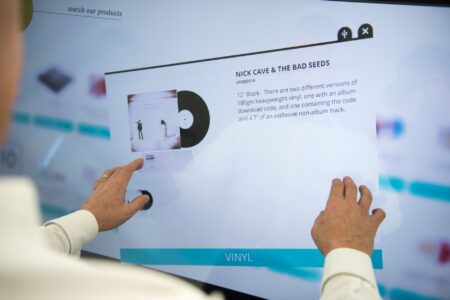
The company has also moved aggressively into self-service territory, building consumer-facing kiosk and QR-linked experiences that let shoppers explore product details, request assistance, or check inventory without flagging down an associate. This dual-sided approach – serving both the associate and the autonomous shopper – gives Mercaux a wedge into store environments where labor costs are under pressure and retailers are actively trying to do more with thinner floor coverage. That’s not a niche use case right now. That’s most of retail.

Salesfloor’s Strength and Its Exposure
Salesfloor built its reputation on associate-to-customer communication – the digital tools that let a store associate text a client, share a curated product selection, or follow up after a visit. That relationship-driven model resonated deeply with luxury and premium retailers where the human connection is the product as much as the merchandise. The platform’s clienteling credentials are genuine, and its customer list includes names across department store and specialty retail that represent serious, long-term contracts.
But clienteling as a standalone category is getting harder to defend. Retailers are consolidating their vendor stacks wherever possible, and a platform that handles clienteling, selling tools, product discovery, and consumer-facing experiences in one license is a more straightforward conversation with a CIO than three separate vendors with three separate integrations. Mercaux is structured to have that conversation.
There’s also a generational pressure at play. Associate populations at major retailers skew younger with each hiring cycle, and those associates are less willing to work across multiple apps and systems. Platforms that feel native – fast, visual, minimal taps to get to the right information – have an advantage that doesn’t show up in feature comparison spreadsheets but absolutely shows up in adoption rates. Mercaux’s interface design has been a consistent point of praise in retail tech evaluations, particularly among non-technical floor staff.
Salesfloor has responded by deepening integrations with established retail ERP and CRM systems – a defensive play that bets on switching costs to hold accounts. If a retailer’s clienteling data is deeply embedded in Salesfloor’s infrastructure and tied into their Salesforce or SAP stack, ripping it out is a genuine operational project, not a checkbox decision. That’s a real moat. The question is whether it’s a growing one or a shrinking one as contract cycles come up for renewal.
Where AI Changes the Margin Math
The specific pressure Mercaux applies comes from what AI-assisted selling actually does to conversion metrics. When an associate can surface the right outfit suggestion in three seconds rather than walking to a rack, the conversation stays warm. When a self-service kiosk captures a customer who would have otherwise walked out because no associate was available, that’s recovered revenue on a day with a staffing gap. Neither of these is hypothetical – they’re the operational scenarios retailers are trying to solve right now, and they’re the scenarios Mercaux’s demos are built around.
For a vendor like Salesfloor, which has historically led with the relationship management angle, the shift in buyer priorities toward measurable floor-level conversion is an uncomfortable one. Clienteling ROI has always been somewhat diffuse – you build the relationship, the customer returns, maybe. AI-assisted selling promises a tighter feedback loop: this tool, this interaction, this sale. That’s a different kind of proof point, and it’s the kind CFOs and operations leaders are currently more receptive to than loyalty metrics.

What Comes Next in the Competitive Stack
Mercaux raised a Series A round in recent years and has been expanding its retail partnerships across Europe and into North America. The company is not yet the scale of Salesfloor in terms of installed base, but it’s competing on the deals that matter most – flagship store technology rollouts at retailers with the budget and appetite to rebuild their in-store digital layer. Winning two or three of those in the next 18 months would substantially change the competitive narrative.
The broader retail tech market is also seeing consolidation pressure from above. Enterprise platforms like Salesforce Commerce Cloud and SAP are pushing their own store associate tools, which creates a ceiling on standalone vendors across the board. Both Mercaux and Salesfloor face that squeeze from larger players with existing relationships. The difference is that Mercaux’s AI-native positioning gives it a story to tell that the legacy enterprise vendors can’t match with retrofitted modules. The enterprise vendors’ in-store tools are functional. They are rarely fast or intuitive enough to change behavior on a busy salesfloor.
The sharpest competitive question facing Salesfloor right now may be whether its next product cycle can absorb the kind of AI-driven, real-time selling assistance that Mercaux has built from the ground up, or whether it ends up defending its clienteling core while ceding the broader associate enablement category to a platform that started there. The accounts where both companies are currently competing will answer that question before any product roadmap does.