
Ultrafast UV-C light just took a leap forward, opening the door to lightning-fast communications and next-generation photonic technologies.
Devices that work with ultraviolet light in the UV-C range (100−280 nm) are becoming increasingly important across many fields, including super-resolution microscopy and optical communications. Scientists are especially interested in UV-C light because it scatters strongly in the atmosphere, a property that makes it useful for non-line-of-sight communication. This means data could be sent even when a clear line of sight is blocked, such as in cluttered or obstructed environments. Despite these advantages, progress has been slow because researchers have lacked practical components that can reliably generate and detect UV-C light.
A New Platform for Ultrafast UV-C Pulses
In a study published in Light: Science & Applications, researchers led by Professor Amalia Patané (University of Nottingham) and Professor John W. G. Tisch (Imperial College London) report a new system that can both create and detect extremely short UV-C laser pulses. Their approach combines an ultrafast UV-C laser source with highly sensitive UV-C detectors made from atomically-thin (two-dimensional) semiconductors (2DSEM).
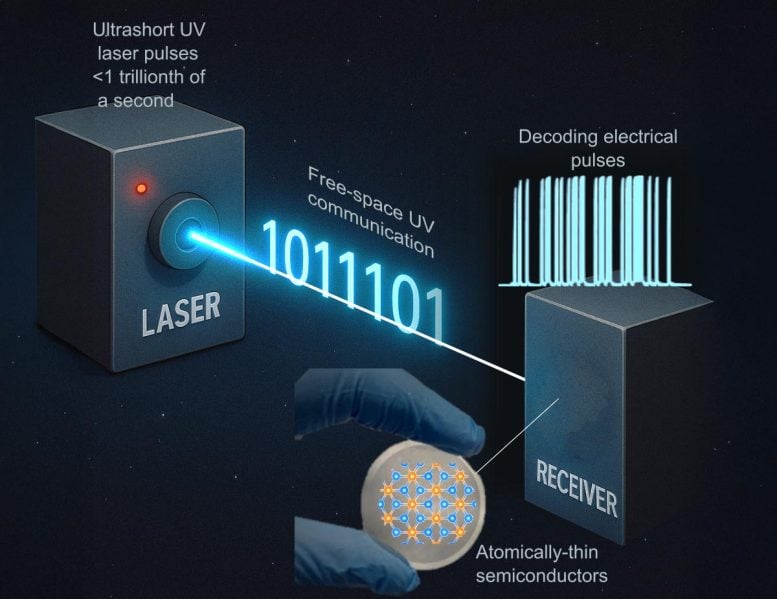
The laser source relies on carefully matched nonlinear optical processes. By using cascaded second-harmonic generation inside nonlinear crystals, the system produces UV-C pulses that last only femtoseconds, less than 1 trillionth of a second. These flashes of light are then detected at room temperature using photodetectors made from the 2DSEM gallium selenide (GaSe) and its wideband gap oxide layer (Ga2O3). Importantly, all of the materials involved are compatible with scalable manufacturing methods.
To demonstrate what the system can do, the team built a free-space communication setup. In this test, information was encoded into the UV-C laser by the transmitter and successfully decoded by the 2D semiconductor sensor acting as the receiver.
Unexpected Sensor Performance
Professor Patané, who led the sensor development, explains the significance of the results: “This work combines for the first time the generation of femtosecond UV-C laser pulses with their fast detection by 2D semiconductors. Unexpectedly, the new sensors exhibit a linear to super-linear photocurrent response to pulse energy, a highly desirable property, laying the foundation for UV-C-based photonics operating on femtosecond timescales over a wide range of pulse energies and repetition rates.”
Ben Dewes, a PhD student at Nottingham, highlights how early this field still is: “The detection of UV-C radiation with 2D materials is still in its infancy. The ability to detect ultrashort pulses, as well as to combine the generation and detection of pulses in free-space, helps pave the way for the further development of UV-C photonic components.”
Efficient UV-C Laser Generation
Professor Tisch, who led the work on the laser source, emphasizes the importance of efficiency: “We have exploited phase matched second-order processes in nonlinear optical crystals for the efficient generation of UV-C laser light. The high conversion efficiency marks a significant milestone and provides a foundation for further optimization and scaling of the system into a compact UV-C source.”
Tim Klee, a PhD student at Imperial, adds that accessibility is key: “A compact, efficient and simple UV-C source will benefit the wider scientific and industrial community, stimulating further research on UV-C photonics.”
Future Applications in Communication and Imaging
Together, the ability to generate and detect femtosecond UV-C laser pulses opens the door to a wide range of new technologies. The sensitivity of 2D semiconductor sensors could enable integrated systems where UV-C light sources and detectors are combined into a single platform. Potential uses include free-space communication between autonomous systems and robotic devices.
Because these components are compatible with monolithic integration in photonic integrated circuits, the approach could also support applications ranging from broadband imaging to ultrafast spectroscopy, all operating on femtosecond timescales.
Reference: “Fast ultraviolet-C photonics: generating and sensing laser pulses on femtosecond timescales” by Benjamin T. Dewes, Tim Klee, Nathan D. Cottam, Joseph J. Broughton, Mustaqeem Shiffa, Tin S. Cheng, Sergei V. Novikov, Oleg Makarovsky, John W. G. Tisch and Amalia Patané, 19 November 2025, Light: Science & Applications.
DOI: 10.1038/s41377-025-02042-2
Never miss a breakthrough: Join the SciTechDaily newsletter.
Follow us on Google and Google News.