

A new chip-based quantum memory uses 3D-printed “light cages” to store light in atomic vapor with high precision.
Quantum information storage plays a central role in the development of the quantum internet and future quantum computers. Today’s quantum communication systems are limited by signal loss over large distances, which restricts how far quantum information can reliably travel. Quantum memories help address this challenge by making quantum repeaters possible, allowing distant parts of a network to be linked through entanglement swapping.
In a study published in Light: Science & Applications, researchers from the Humboldt-Universität zu Berlin, the Leibniz Institute of Photonic Technology, and the University of Stuttgart report a new method for building quantum memories. Their approach uses 3D-nanoprinted structures known as “light cages” that are filled with atomic vapor. By bringing both light and atoms together on a single chip, the technology offers a scalable and integrable platform for next-generation quantum photonic systems.
Light Cage Technology
Light cages are a type of hollow-core waveguide designed to tightly confine light while still allowing access to the interior from the sides. This design sets them apart from conventional hollow-core fibers, which can take months to fill with atomic vapor. In contrast, the nanoprinted light cages enable cesium atoms to diffuse into the structure much more quickly, cutting filling times down to just a few days without sacrificing strong optical confinement.
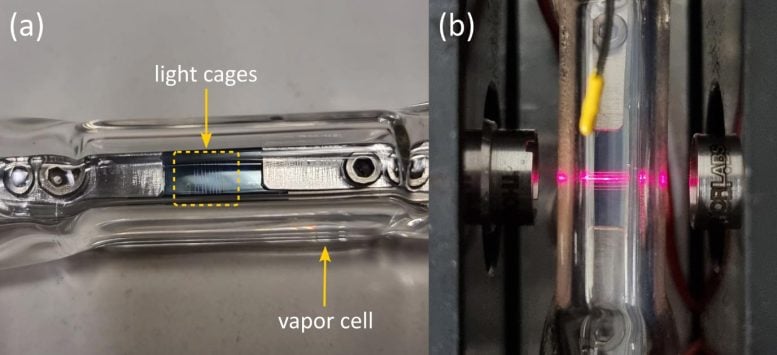
The researchers produce the structures using two-photon polymerization lithography carried out on commercial 3D printing systems. This technique allows highly detailed hollow-core waveguides to be formed directly on silicon substrates with exceptional precision. To protect the devices from the highly reactive cesium vapor, the waveguides are covered with a protective coating, and tests show no signs of degradation even after five years of continuous use.
“We created a guiding structure that allows quick diffusion of gases and fluids inside its core, with the versatility and reproducibility provided by the 3D-nanoprinting process. This enables true scalability of this platform, not only for intra-chip fabrication of the waveguides but also inter-chip, for producing multiple chips with the same performance,” explained the research team.
Performance as Quantum Memory
The light cages enable highly efficient conversion of guided light pulses into collective atomic excitations. After a chosen storage period, an optical control laser can reverse the process, releasing the stored light on demand. In a key milestone, the team successfully stored attenuated light pulses containing only a few photons for durations of several hundred nanoseconds. Looking ahead, the researchers are optimistic about extending this capability to the storage of single photons for many milliseconds.
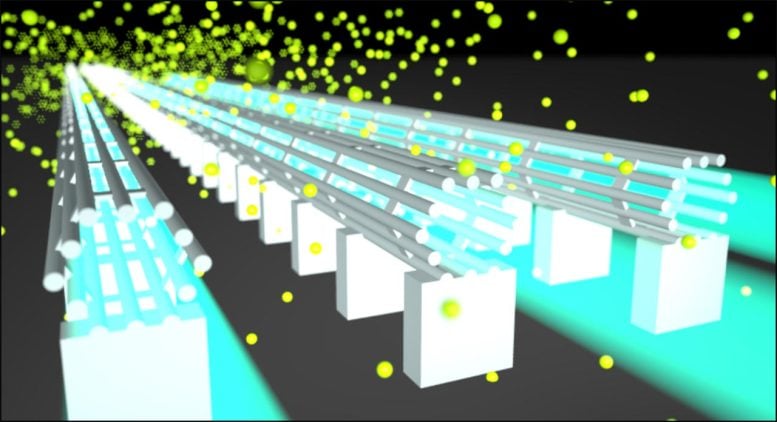
A most significant achievement for application in scalable quantum technology was the successful integration of multiple light cage memories onto a single chip within a cesium vapor cell. The team demonstrated that different light cages with identical geometrical parameters exhibit nearly identical storage performance for two different devices on the same chip.
This reproducibility stems from the exceptional precision of the 3D-nanoprinting process, which achieves intra-chip structure variations of less than 2 nanometers and inter-chip variations of less than 15 nanometers. Such consistency is crucial for the spatial multiplexing concept that could revolutionize quantum memory integration.
Impact and Future Prospects
The light cage quantum memory platform addresses critical challenges in quantum technologies. In quantum repeater networks, these memories could enable parallel single-photon synchronization, dramatically improving the efficiency of long-distance quantum communication. For photonic quantum computing, they offer controllable delays necessary for feed-forward operations in measurement-based quantum computing architectures.
The compact size and room-temperature operation of the system provide significant practical advantages over competing technologies that require cryogenic cooling or complex atomic trapping systems. The platform operates at slightly above room temperature, excelling in practicality with higher bandwidths per memory mode compared to alternative approaches. The ability to fabricate multiple quantum memories on a single chip with reproducible performance characteristics opens the door to large-scale quantum photonic integration. The versatility of the fabrication process, combined with the potential for direct fiber coupling and integration with existing photonic technologies, positions light cage memories as a key enabling technology for future quantum networks.
The development of light-cage quantum memories represents a major step forward in quantum photonic technology. By combining advanced 3D-nanoprinting techniques with fundamental quantum optics principles, the researchers have created a scalable platform that could accelerate the development of quantum communication networks and quantum computing systems.
Reference: “Light storage in light cages: a scalable platform for multiplexed quantum memories” by Esteban Gómez-López, Dominik Ritter, Jisoo Kim, Harald Kübler, Markus A. Schmidt and Oliver Benson, 1 January 2026, Light: Science & Applications.
DOI: 10.1038/s41377-025-02085-5
Funding: German Research Foundation (DFG), Federal Ministry of Education and Research (BMBF)
Never miss a breakthrough: Join the SciTechDaily newsletter.
Follow us on Google and Google News.