

Ocean waves offer a massive and steady source of renewable energy, but capturing that power efficiently has remained a stubborn challenge.
A researcher at the University of Osaka has explored a new solution: a gyroscopic wave energy converter that uses a spinning flywheel inside a floating platform to generate electricity.
Ocean Waves Offer Vast Untapped Energy
Ocean waves are among the most plentiful and reliable sources of renewable energy on Earth. However, turning that constant motion into usable electricity has proven difficult. Most existing wave energy systems work efficiently only under specific conditions, which limits their usefulness in the ever changing ocean environment. This has created a need for more flexible and effective technologies.
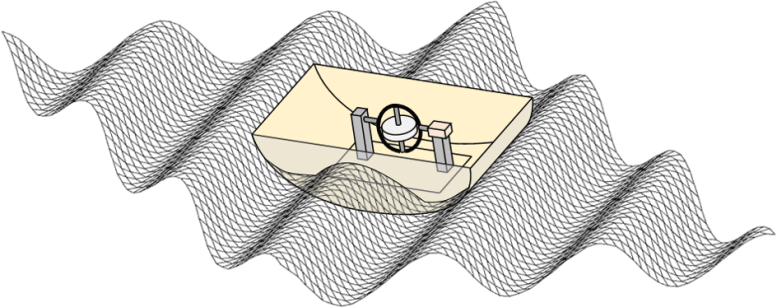
New Gyroscopic Wave Energy Converter Design
A researcher from the University of Osaka has investigated a new type of system designed to overcome these limitations. The device, known as a gyroscopic wave energy converter (GWEC), was evaluated for its ability to support large-scale power generation. The results of this work were published in the Journal of Fluid Mechanics.
The GWEC produces electricity using a spinning flywheel housed within a floating structure. As the platform moves with the waves, the flywheel converts that motion into energy. Because the system relies on gyroscopic behavior, it can be adjusted to capture energy efficiently across a wide range of wave frequencies instead of just a narrow band.
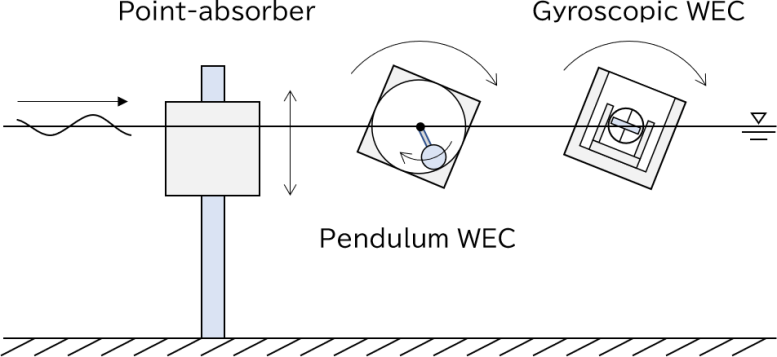
How Gyroscopic Precession Generates Power
The key mechanism behind the device is gyroscopic precession, which occurs when a spinning object responds to an external force. When waves cause the floating structure to pitch (move up and down), the spinning flywheel changes its orientation through precession (changing the direction it is spinning in). This motion is linked to a generator, allowing the system to produce electricity.
“Wave energy devices often struggle because ocean conditions are constantly changing,” says Takahito Iida, author of the study. “However, a gyroscopic system can be controlled in a way that maintains high energy absorption, even as wave frequencies vary.”
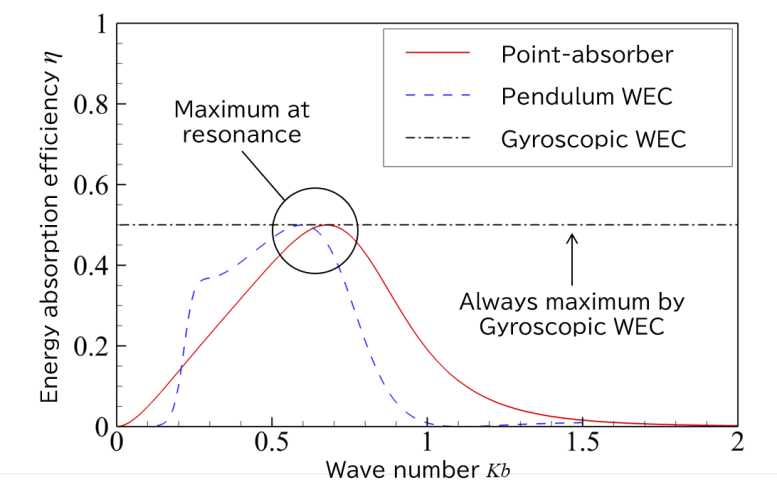
Modeling Efficiency Across Wave Conditions
To understand how the system performs, researchers used linear wave theory to model the interactions among ocean waves, the floating platform, and the gyroscope. By examining these relationships, they identified the best settings for the flywheel’s speed and the generator’s operation. Their analysis showed that, when properly tuned, the GWEC can reach the theoretical maximum energy absorption efficiency of one-half at any wave frequency.
“This efficiency limit is a fundamental constraint in wave energy theory,” explains Iida. “What is exciting is that we now know that it can be reached across broadband frequencies, not just at a single resonant condition.”
Simulations Support Real World Performance
The team tested these findings with numerical simulations in both the frequency and time domains. Additional time-domain simulations included nonlinear gyroscopic effects to assess potential limitations. The results showed that the device maintains strong efficiency near its resonance frequency, meaning it performs best when its motion aligns with the natural rhythm of the waves.
By demonstrating how to fine-tune the gyroscope for optimal performance, the study outlines a clear path toward more adaptable wave energy systems. As the demand for dependable renewable energy grows, innovations like this could help tap into the enormous energy potential of the oceans.
Reference: “Linear analysis of a gyroscopic wave energy converter: absorbing half of the wave energy over broadband frequencies” by Takahito Iida, 17 February 2026, Journal of Fluid Mechanics.
DOI: 10.1017/jfm.2026.11172
Never miss a breakthrough: Join the SciTechDaily newsletter.
Follow us on Google and Google News.