
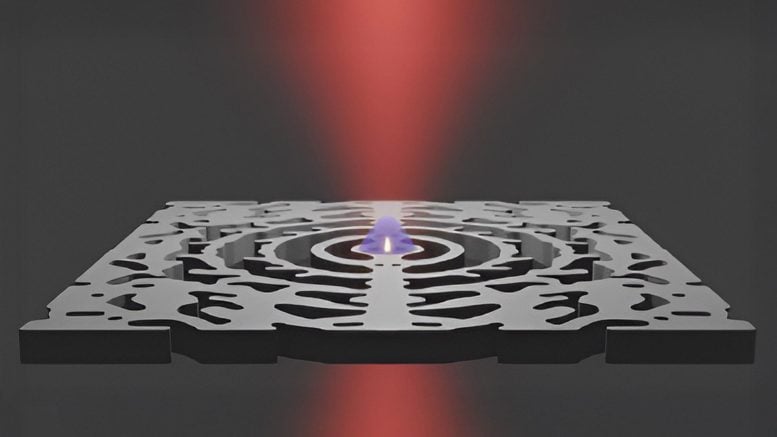
Researchers have created an ultra-compact nanolaser that could transform how data moves within microchips, replacing electrical signals with light.
The idea of computers communicating with light instead of electricity is moving closer to reality, thanks to a breakthrough nanolaser developed at the Technical University of Denmark (DTU).
Described in Science Advances, the device is small enough to be embedded by the thousands onto a single microchip. Instead of relying on electrical currents, which generate heat and slow performance, these nanolasers could transmit information using photons. This shift could dramatically increase processing speeds while reducing energy demands across everything from smartphones to massive data centers.
“The nanolaser opens up the possibility of creating a new generation of components that combine high performance with minimal size. This could be in information technology, for example, where ultra-small and energy-efficient lasers can reduce energy consumption in computers, or in the development of sensors for the healthcare sector, where the nanolaser’s extreme light concentration can deliver high-resolution images and ultrasensitive biosensors,” says DTU professor Jesper Mørk.
Mørk worked on the study with colleagues including Drs. Meng Xiong and Yi Yu from DTU Electro.
Halving computers’ energy use
While the internet already relies on light to move data through fiber optic cables, computers still depend on electrical signals within their internal circuits. This creates heat and limits performance. Introducing nanolasers directly onto chips could overcome these issues by enabling faster data transfer with minimal energy loss. Mørk estimates that this technology could reduce computer energy consumption by about half.
The DTU nanolaser is designed to fit this role, as future chips are expected to require thousands of compact, energy-efficient light sources to transmit signals internally.
A technological breakthrough
Built in DTU’s cleanroom facility, DTU Nanolab, the device challenges long-standing assumptions about how small lasers can be. It relies on a light-trapping structure, known as a nanocavity, that concentrates light into an extremely small space once thought unattainable.
When activated with a light beam, both light and electrons become confined within this tiny region. This allows the laser to operate at room temperature while using very little energy.
The nanocavity design was originally developed by Professor Ole Sigmund’s group at DTU Construct.
Faster technology, less CO₂, and better sensors
A key next step is enabling the nanolaser to run on electrical power, which remains a major research challenge. If achieved, the technology could reshape multiple industries. Consumer devices could become more powerful while using less energy, and data centers could cut their electricity demands, lowering their environmental impact. In healthcare, the same technology could support highly sensitive sensors and sharper imaging tools.
Researchers believe the remaining technical hurdles could be addressed within the next 5–10 years.
Reference: “A nanolaser with extreme dielectric confinement” by Meng Xiong, Yi Yu, Yury Berdnikov, Simon Klinck Borregaard, Adrian Holm Dubré, Elizaveta Semenova, Kresten Yvind and Jesper Mørk, 17 December 2025, Science Advances.
DOI: 10.1126/sciadv.adx3865
Funding: Danish National Research Foundation, European Union Horizon 2020 Research and Innovation Programme, Villum Fonden Young Investigator Program
Never miss a breakthrough: Join the SciTechDaily newsletter.
Follow us on Google and Google News.